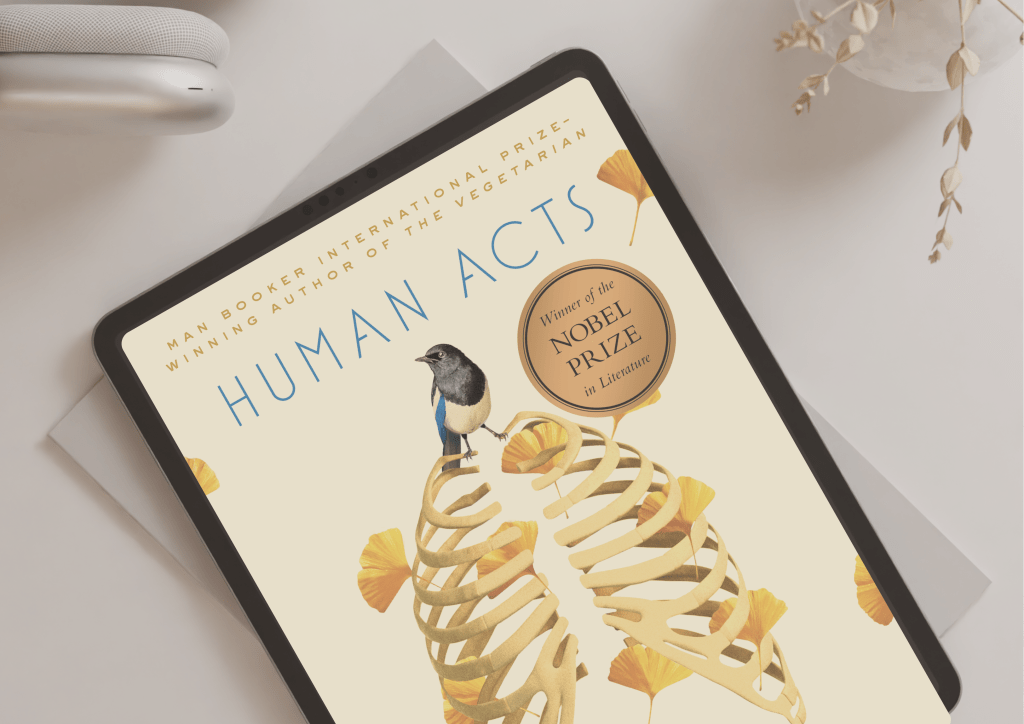
“Is it true that human beings are fundamentally cruel? Is the experience of cruelty the only thing we share as a species?”
I shouldn’t have taken it with a grain of salt when Pepe Diokno shared how this book wrecked him. Now, it feels like secondhand PTSD: the trauma is real.
I’ve always been a fan of Murakami for his surreal, dreamlike narratives, but now I understand why Han Kang, not him, received last year’s Nobel Prize for Literature. Human Acts is not just disturbing—it’s devastating. A raw, unfiltered exploration of the brutality humans inflict on one another, the novel reconstructs the horrors of the Gwangju Uprising against General Chun Doo-hwan’s military dictatorship, unearthing the depths of human cruelty with painful precision.
Told through interwoven perspectives in each chapter—like a more harrowing The Five People You Meet in Heaven—the novel humanizes the pain of history. But unlike fiction designed to comfort or inspire, Human Acts offers no reprieve. These are real events, real deaths, real suffering. The grief isn’t just historical—it lingers, passed down through survivors and the loved ones left behind.
The story begins with a young boy, innocent yet caught in the violent storm of political upheaval. His death becomes the haunting thread that ties the book together, culminating in the perspective of his mother—a woman left to wrestle with guilt, remorse, and a simmering rage over the injustice of her son’s death. Jodi Picoult once wrote in My Sister’s Keeper: “A child who loses his parents is called an orphan. There is no word for a parent who loses a child. That’s how awful the loss is.”
Han Kang does not shy away from the gruesome, unthinkable realities of torture and state-sanctioned murder. She does not dilute the trauma. The novel confronts not only the physical violence but also the estrangement survivors feel from their own humanity—how oppression lingers long after the bodies are buried. Even after nearly five decades, the scars of the Gwangju Uprising remain, echoing into the present with chilling modern-day parallels.
And that is perhaps what makes this book even more unsettling—these atrocities are not unique to South Korea. The same horrors have unfolded in Cambodia, Vietnam, and, of course, in our own country, the Philippines. Stories of mistaken identity, desaparecidos, and the brutalization of the innocent at the hands of those in power remain terrifyingly familiar.
At its core, Human Acts forces us to confront the question: Are we inherently violent? Or is it power that corrupts us into monsters? It’s like the real-world execution of the Stanford Prison Experiment, proof of how easily authority can strip away our morality.
But, perhaps the most crucial message of the book is the importance of remembrance. To tell these stories is to give voice to those who have not lived long enough to tell the tale—even when the act of telling demands that we relive the nightmare over and over again.
Human Acts is not an easy read. Each chapter shifts between different voices and perspectives, making the narrative initially confusing, but once you understand why, it becomes devastatingly clear. It’s a painful, deliberate choice, a storytelling method as genius as it is gut-wrenching. This book will not make you cry in the way Paulo Coelho’s emotional rollercoasters do. Instead, it will leave you with a deeper, more unsettling kind of pain—the kind that keeps you up at night, enraged, grief-stricken, and helpless.
Probably the reason why Human Acts struck me so deeply is because I have met people who lived through similar nightmares. I have heard their stories firsthand. And it forces me to ask:
Would those who openly support the killing of suspected ‘criminals’ and ‘drug users’ feel the same way if the person they loved ended up being one of the falsely accused? Would they still call it justice?
What has become of our humanity?
Disturbing Quotes from ‘Human Acts’
But the generals are rebels, they seize power unlawfully. You must have seen it: people being beaten and stabbed in broad daylight and even shot.
The Cambodian government has killed another two million of theirs. There’s nothing stopping us from doing the same.
But the assassination was no victory for democracy.
“Faithfulness” in translation primarily concerns the effect on the reader rather than issue of syntax.
Repressed trauma erupts in the form of memory.
There are no souls here. There are only silenced corpses and that horrific putrid stink.
The soldiers are the scary ones. What’s frightening about the dead?
She wanted this damned, dreary life not to drag on too long.
But life still lingered on for her, with hunger still a yoke around her neck.
Pain so intense I felt sure I was going to lose my mind, so horrific that I literally did lose control of my body, pissing and shitting myself.
Our experiences might have been similar, but they were far identical.
Some memories never heal. Rather than fading with passage of time, those memories become the only things that are left behind when all else is abraded.
Is it true that human beings are fundamentally cruel? Is the experience of cruelty the only thing we share as a species?
I’m fighting, alone, every day. I fight with the hell that I survived.
I could never believe in the existence of a being who watches over us with consummate love.
Only the young can be so stubborn, so decisive in the face of their own fear.
But I don’t have a map for whatever world lies beyond death.
How had the seasons kept on turning for me, when time had stopped forever for him that May?
 Dakilanglaagan